No fees unless we win—our success is your success. If there’s no result, you pay nothing.
Can’t come to us? We’ll come to you! We’ll personally visit to hear your case and provide tailored legal guidance.
Join the hundreds of satisfied clients we’ve successfully represented. Your case deserves the same commitment and expertise.
In the United States, accidents are a significant cause of death. Families often wonder what steps they can take after an unexpected loss, and in simple terms, a wrongful death lawyer Chicago can help them understand their legal options clearly. After a sudden death, families must cope with emotional loss and unexpected expenses, which often leaves them searching for directions.
We understand the value of reaching out at the right time for help. If you’re unsure when to speak with an attorney, here’s a helpful guideline: reaching out early often provides clarity about your rights. Contact us now for a FREE, no-obligation consultation about wrongful death cases. Our dedicated wrongful death lawyers Chicago team is here to help your family pursue rightful compensation.
Is Wrongful Death a Crime?
Many families ask this first. In simple terms, no — wrongful death lawsuits are civil claims, not criminal charges. Civil laws differ from criminal laws, and skilled litigators, like experienced wrongful death lawyers, can explain these differences and help determine the best approach for your situation while keeping everything easy to understand.
The Centers for Disease Control and Prevention (CDC) reports that unintentional injuries are the leading cause of death among people aged 1–44. The Illinois Department of Public Health (IDPH) notes that motor vehicle accidents and other incidents are among the top causes of death statewide. These statistics often lead families to ask whether contacting a wrongful death attorney Chicago is necessary. It often depends on the circumstances, but reaching out to an attorney early can provide clarity.
Wrongful Death Act
In Illinois, surviving family members can seek compensation under specific laws. Families often ask what these laws mean for them, and here is a simple explanation:
Illinois Wrongful Death Act: This act allows surviving family members to file a wrongful death claim. It enables them to seek monetary compensation related to the family’s losses, such as:
• Loss of consortium
• Loss of companionship
• Loss of services
• Loss of future income
Illinois Probate Act: Under this law, a deceased person’s family may pursue compensation that the individual could have collected during their lifetime. This statute focuses on the victim, and through an estate, the family can file a legal claim.
In survival claims, the probate court appoints an executor to handle the decedent’s estate. The executor may claim damages the victim could have pursued, typically based on losses experienced between the injury and the time of death, such as:
• Past lost wages
• Medical bills
• Disability
• Pain and suffering
• Property damage
Our Chicago wrongful death attorneys Chicago team works to help families recover maximum damages. We manage the legal complexities so you can focus on supporting your loved ones.
Our Chicago Wrongful Death Attorney Maximizes Your Claim’s Success
Chicago Injury Lawyer understands what families need most during challenging times. Many families seek answers, closure, and financial support to move forward, and we focus on helping them achieve all three.
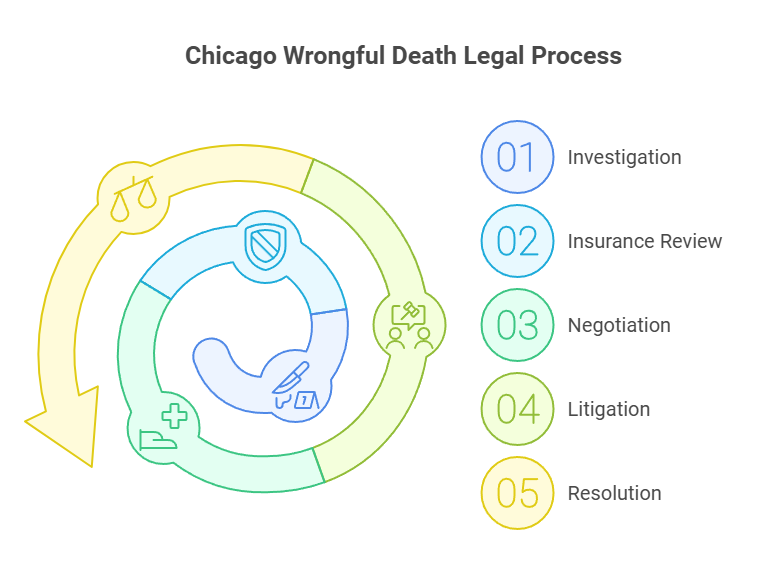
We have a skilled, experienced, and dedicated legal team ready to help in several ways:
Investigation: We gather evidence and identify who should be held accountable for your loved one’s death.
Insurance Review: Insurance coverage often determines a claim’s recovery amount, so we review all policies to ensure every compensation avenue is explored.
Negotiation: Our wrongful death attorneys Chicago will negotiate with insurance companies on your behalf to help secure a fair settlement.
Litigation: If needed, we will defend you in court and present a compelling case using modern strategies.
Resolution: We ensure that any compensation is properly collected and distributed, including payments involving liens.
If you’re still unsure about your next step, here’s a helpful thought: reaching out for guidance can provide clarity and reduce stress.
Unexpected Wrongful Death: Who Is Liable?
Many families ask who can be held responsible after a sudden loss, and in simple terms, liability depends on the facts of the case. A person or entity may be responsible if their negligence or wrongful act caused the death.
Motor Vehicle Accidents
Motor Vehicle Accidents: Families often wonder which party is liable after a crash. Responsibility can vary depending on the type of accident. These may include:
When a pet causes injuries resulting in wrongful death, the owner may be held responsible. This often depends on prior behavior, negligence, or failure to control the animal.
Medical Malpractice
In many situations, wrongful death linked to medical error can involve diagnosis mistakes, medication errors, surgical mistakes, misdiagnosed cancers, or radiological errors. Families often ask whether worsening conditions qualify, and in simple terms, they can if negligence contributed to the outcome.
Nursing Home Abuse
Wrongful death can occur when nursing home staff or administrators act negligently. In some cases, these tragedies stem from physical or sexual abuse.
Workplace Accidents
Workplace-related injuries may also create liability when the employer contributed to unsafe conditions. When a worker dies on the job, their family may be able to pursue additional claims beyond workers’ compensation. This typically applies when the employer did not directly cause the death but another party played a role. This way allows for additional legal claims beyond workers’ compensation.
Product Defect
Wrongful death claims may also arise when a product defect causes fatal harm. Examples include toxic food, unsafe consumer items, or malfunctioning vehicle parts.
Police Shootings
Families sometimes ask whether they can pursue a claim for a fatal police encounter. In many cases, they may file a lawsuit against the police department and responsible officers.
We offer compassionate support and understand the emotional and financial strain you may be facing. Our goal is to help reduce stress by guiding you through each step of the legal process.
Wrongful Death Legal Cost Estimator (Illinois)
Elements Of A Wrongful Death Claim
Wrongful death lawsuits resemble personal injury claims, except the victim suffers fatal injuries. Families often ask what must be proven, and there are the four key elements:
If a death is claimed in a lawsuit, the plaintiff must prove that negligence caused the death. The reasons might be negligent or intentionally harmful, such as violence.
1. Duty
The Chicago wrongful death attorney must prove that the accused owed a duty of care to the deceased. The lawyer must establish a clear connection between the defendant’s actions and the fatal outcome.
2. Breach of duty
The action could be direct, like running through a red light at high speeds. Inaction can also be the cause; someone else would have acted differently under similar circumstances. Attorneys must show the defendant breached this duty, whether through direct action or failure to act.
3. Damages
The attorney must prove negligence resulted in specific injuries, losses, or harms to the victim and their loved ones. Furthermore, he must demonstrate how severe the damages are.
4. Causation
Finally, lawyers must establish a direct link between the defendant’s actions and the fatal outcome. The defense lawyer must establish causation and demonstrate that the client’s negligence directly caused the harm, not other factors. If the defendant’s negligence prevented the death, the plaintiff’s attorney may prove that the death wouldn’t have occurred.
As a reminder, punitive damages cannot be awarded in the Chicago wrongful death or survival lawsuit.
Who is Eligible to File a Wrongful Death Claim?
Families often ask who can bring a wrongful death action, and in simple terms, eligibility is defined by Illinois law.
According to 740 ILCS 180/1, the surviving spouse and next of kin are entitled to file a wrongful death claim. In Illinois, “next of kin” typically includes:
When there are no surviving spouses or next of kin, wrongful death actions may instead benefit:
• Individuals or groups who provided hospital services during the decedent’s last illness or injury.
In many situations, families ask whether they still have time to file. In simple terms, you can file a wrongful death claim if it has been less than two years since your loved one’s passing.
Chicago Wrongful Death Statute Of Limitations
A statute of limitations applies to wrongful death claims in Illinois. This time limit controls how long families have to file a lawsuit. According to The Illinois Wrongful Death Act, the death of a decedent triggers a 2-year statute of limitations. However, there are some exceptions.
A medical malpractice claim may be filed within two years of discovering the injury, with a maximum of four years from the negligent act or omission. The “discovery rule” applies in these cases. Accordingly, you have 4 years from the date of the negligent act or omission to claim.
Claims against a government agency must be filed within one year. If you have questions about the case or notice requirements, consult our wrongful death lawyers in Chicago.
If the deceased was under 18, a wrongful death claim may be filed within two years of their passing.
Call Now. Get Your Free Case Review Today!
Families often feel overwhelmed after a sudden loss, and reaching out for guidance can help provide clarity. At Chicago Personal Injury Lawyer, we are committed to helping those who have lost loved ones due to another’s negligence.
We always offer free initial consultations. During your consultation, you and our attorney can discuss the details and determine how we may help you pursue justice.
While you focus on grieving and healing, our wrongful death lawyers in Chicago will handle all legal matters efficiently and respectfully.
For more Information, please fill out our online form or contact us now by phone 312-261-5656.
If you’re unsure about your next step after losing someone you love, it may be helpful to reach out for clarity and support. Speaking with a wrongful death lawyer Chicago can help you understand your options and learn what may be possible for your family. Our team is here to guide you through the process with care, answer your questions in plain language, and help you move forward at a pace that feels right for you. Whenever you feel ready, we are here to listen and offer guidance without pressure or obligation.
Chicago Wrongful Death FAQ
General Overview Questions
FAQ
Frequently Asked Questions
What is a wrongful death in Illinois?
A wrongful death occurs when a person dies due to the negligent, reckless, or intentional actions of another party. In Illinois, these cases are governed by the Illinois Wrongful Death Act (740 ILCS 180) and allow surviving family members to recover damages for their loss.
Does Chicago have a cap on wrongful death damages?
There is no damage cap in Illinois for wrongful death claims. A previous law limiting non-economic damages was overturned by the Illinois Supreme Court in 2010.
How Are Wrongful Death Proceeds Divided in Chicago?
Wrongful death proceeds in Illinois are divided among the next of kin according to their level of dependency and relationship to the deceased. A judge determines how the settlement or verdict is allocated between eligible family members.
Who can be sued in a wrongful death and accident case?
Many families wonder who may be held responsible in a wrongful death case. Depending on the circumstances, responsible parties may include another driver, a co-worker, an employer, a doctor, anesthesiologist, nurse, hospital, healthcare provider, or even a pet owner.
How long do I get support?
You receive full support for the entire duration of your Chicago wrongful death case. Your attorney will stay with you through every stage of the process—answering questions, providing updates, dealing with insurance companies, and guiding you until the claim is fully resolved through settlement or trial.
What qualifies as a wrongful death claim?
A claim qualifies as wrongful death when the death would have supported a personal injury lawsuit if the person had survived. Common causes include negligence, medical malpractice, car accidents, dangerous property conditions, and criminal acts.
Who can file a wrongful death lawsuit in Illinois?
n Illinois, only the personal representative of the deceased person’s estate may file a wrongful death lawsuit. However, the compensation recovered is distributed to surviving family members such as the spouse, children, or other next of kin.
What is the difference between wrongful death and survival actions?
A wrongful death claim compensates surviving family members for their losses, such as grief, loss of support, and loss of companionship.
A survival action compensates the estate for the damages the deceased person suffered before death, such as pain and suffering and lost wages.
How does a wrongful death claim work?
A wrongful death claim seeks compensation for the losses suffered by surviving family members. It involves proving negligence, collecting evidence, valuing damages, and negotiating or litigating for fair compensation.
What are the most common causes of wrongful death?
Common causes of wrongful death include motor vehicle crashes, medical malpractice, nursing home neglect, workplace accidents, defective products, and unsafe property conditions.
Do I need a lawyer for a wrongful death claim?
Yes. Wrongful death cases involve complex laws, strict deadlines, insurance companies, and significant financial stakes. An experienced wrongful death lawyer can investigate the case, deal with insurers, and work to maximize compensation for your family.
How long does a wrongful death case usually take?
A wrongful death case can take anywhere from several months to a few years, depending on disputes over fault, the complexity of the evidence, the amount of insurance involved, and whether the case settles or goes to trial.
Can multiple family members join a wrongful death lawsuit?
The lawsuit itself is filed by the personal representative, but multiple family members may share in the compensation. A judge decides how the settlement or verdict is divided among eligible next of kin based on their relationship and level of dependency.
Legal & Statutory Questions FAQ
What is the Illinois Wrongful Death Act?
The Illinois Wrongful Death Act (740 ILCS 180) is the law that governs wrongful death claims in Illinois. It explains who may file a lawsuit, what damages can be recovered, and how compensation is distributed among surviving family members.
What is the statute of limitations for wrongful death in Illinois?
Most wrongful death lawsuits in Illinois must be filed within two years of the date of death, under 740 ILCS 180/2. Missing this deadline can result in losing the right to pursue compensation.
Are there exceptions to the statute of limitations for wrongful death?
Yes. Wrongful death cases involving medical malpractice, government entities, or criminal conduct may have different or shorter deadlines. It is important to speak with an attorney as soon as possible so important time limits are not missed.
What damages can be recovered in an Illinois wrongful death case?
In Illinois, wrongful death damages may include loss of financial support, loss of companionship and society, loss of services, funeral and burial expenses, and compensation for the surviving family’s grief and sorrow, as allowed under 740 ILCS 180/2.
Who receives compensation in a wrongful death case?
Compensation in a wrongful death case is awarded to the deceased person’s next of kin, such as a surviving spouse, children, or parents. A judge determines how the recovery is divided based on each person’s relationship to and dependency on the deceased.
Can punitive damages be awarded in Illinois wrongful death cases?
Illinois law does not allow punitive damages in wrongful death claims. However, punitive damages may be available in a related survival action if the defendant’s conduct was especially reckless or intentional.
What does next of kin mean under Illinois law?
In Illinois, next of kin typically includes the surviving spouse and children of the deceased. If there is no spouse or child, parents or other close relatives may be considered next of kin depending on the circumstances.
Who can serve as the personal representative in a wrongful death case?
A personal representative is often a surviving spouse or adult child of the deceased, but if there is no obvious choice, the court may appoint a parent, another relative, or a qualified third party to serve in this role.
Can siblings file a wrongful death lawsuit in Illinois?
Siblings may be part of the next of kin who receive compensation, but the lawsuit itself must be filed by the personal representative of the estate. In some situations, a sibling can be appointed as the personal representative and file the case.
How is fault determined in Illinois wrongful death cases?
Illinois uses a modified comparative negligence system. If the deceased person was less than 50 percent at fault, the family can still recover damages, but the amount is reduced by the person’s share of fault. If the deceased was more than 50 percent at fault, no recovery is allowed.
Process & Filing Questions
How do you file a wrongful death lawsuit in Illinois?
To file a wrongful death lawsuit, the personal representative files a complaint in civil court against the at-fault party or parties. An attorney prepares the complaint, gathers evidence, files legal motions, and handles negotiations and court appearances on the family’s behalf.
What evidence is needed for a wrongful death claim?
Evidence in a wrongful death case may include accident or incident reports, medical records, photos or videos, witness statements, employment and financial records, and expert testimony such as accident reconstruction or medical opinions.
What happens after a wrongful death lawsuit is filed?
After a wrongful death lawsuit is filed, the case moves into discovery, where both sides exchange evidence and take depositions. Settlement negotiations usually take place during or after discovery. If no agreement is reached, the case may go to trial.
How do you prove negligence in a wrongful death case?
To prove negligence in a wrongful death case, you must show that the defendant owed a duty of care, breached that duty, caused the death, and that surviving family members suffered damages as a result. This often requires a detailed investigation and expert support.
How long does it take to receive compensation in a wrongful death case?
The time to receive compensation varies. Some cases settle in months if liability is clear and insurance coverage is straightforward. More complex or disputed cases, especially those that go to trial, can take several years to resolve.
What if the at-fault party denies responsibility for the wrongful death?
If the at-fault party denies responsibility, your attorney may work with accident reconstructionists, medical experts, or other specialists to show how the death occurred and why the defendant is legally responsible.
Can wrongful death cases be settled out of court?
Yes. Many wrongful death cases are resolved through settlement negotiations or mediation rather than a trial. A fair settlement can provide the family with compensation while avoiding the stress, time, and uncertainty of a courtroom verdict.
What role does insurance play in a wrongful death claim?
Insurance coverage often determines how much compensation is realistically available in a wrongful death case. Auto insurance, commercial policies, homeowners insurance, or employer policies may all play a role depending on how the death occurred.
Scenario-Based Questions
What if the wrongful death was caused by medical malpractice?
When wrongful death is caused by medical malpractice, additional rules and deadlines apply. These cases usually require early investigation, review of records, and testimony from medical experts to show that the standard of care was violated and caused the death.
What if the wrongful death involved a child?
Illinois allows parents to pursue a wrongful death claim for the loss of a child. Damages may include emotional suffering, loss of companionship, and other losses caused by the child’s death.
Can I file a wrongful death claim if the victim was partially at fault?
Yes, you may still be able to file a wrongful death claim if the victim was partially at fault, as long as the victim was less than 50 percent responsible. Any compensation awarded will be reduced by the victim’s percentage of fault.
What if the at-fault driver was uninsured?
If the at-fault driver was uninsured, you may still pursue compensation through uninsured motorist coverage, employer policies, or other available insurance sources. An attorney can help identify all possible avenues for recovery.
Can you sue a government entity for wrongful death?
Yes, it is sometimes possible to bring a wrongful death claim against a city, county, or the State of Illinois, but these cases fall under the Tort Immunity Act and have strict notice requirements and shorter deadlines. It is important to act quickly in these cases.
What if the death occurred at work?
If the death occurred at work, workers’ compensation death benefits may be available. In addition, the family may be able to file a separate wrongful death claim against any third party, such as a contractor, manufacturer, or property owner who contributed to the death.
What if the deceased had no spouse or children?
If the deceased had no spouse or children, parents, siblings, or other next of kin may still receive compensation, depending on their relationship and dependency. A court will determine how any recovery is allocated.
Can you file a wrongful death lawsuit if criminal charges are pending?
Yes. A civil wrongful death lawsuit is separate from any criminal case. The family may pursue a wrongful death claim even if criminal charges are pending, if the defendant was not convicted, or if prosecutors choose not to file charges.
Financial & Practical Questions
How are wrongful death settlements calculated?
Wrongful death settlements are based on factors such as the deceased person’s income and earning potential, the value of lost benefits and services, the closeness of family relationships, the impact of the loss on surviving family members, and funeral and related expenses.
How is compensation divided among family members?
Compensation is divided among family members according to Illinois law and the court’s judgment. The court considers each person’s relationship to the deceased and level of dependency when deciding how to allocate the recovery.
Are wrongful death settlements taxable?
In most cases, wrongful death settlements are not taxable as income under federal law. However, certain portions, such as punitive damages in a related survival action, may be taxable. Families should consult a tax professional for advice on their specific situation.
How much does it cost to hire a wrongful death lawyer?
Most wrongful death lawyers work on a contingency fee basis, which means there are no upfront fees. The attorney is paid a percentage of the settlement or verdict, and if there is no recovery, there is usually no fee for attorney services.
Will the at-fault party go to jail for wrongful death?
A wrongful death lawsuit is a civil case and does not by itself result in jail time. Jail or prison is only possible if the at-fault party is charged and convicted in a separate criminal case brought by the state.
What should families do immediately after a wrongful death?
After a wrongful death, families should focus on safety and immediate needs, avoid making detailed statements to insurance companies, preserve any evidence they can, keep important documents and photos, and contact an experienced wrongful death attorney as soon as possible to protect their rights.