


If you’ve been hit by a semi or a large commercial truck, you already know these are not ordinary car crashes. A loaded tractor-trailer can weigh 20 to 30 times what your car weighs, so the injuries are usually worse, the insurance companies fight harder, and there are often several parties pointing fingers at each other. I’m Paul Marriett, and I’ve spent my career representing people who were seriously hurt through no fault of their own — not settling cases on an assembly line, but building each one to win.
Here’s what that means for you: when you call our office, you talk to a lawyer who has actually tried these cases in front of a jury, not a case manager. I trained at the Gerry Spence Trial Lawyers College, and I bring that trial-ready approach to every truck claim — because trucking companies and their insurers settle for what you deserve only when they believe you’re prepared to take them to court.
Call us now at 312-261-5656 for a free, no-obligation consultation, available 24/7. With our no-fee-unless-we-win policy, you can focus on your recovery while we handle the rest.
How I Handle Your Truck Accident Case
Truck cases move fast in the first few weeks, and the evidence that wins them disappears just as fast. Here’s how my team approaches your claim from day one.
A free, honest case review
We start with a conversation that costs you nothing. I’ll walk through what happened, tell you plainly whether you have a case, and explain what it’s likely worth. You won’t get a hard sell — you’ll get a straight answer.
Moving quickly to preserve evidence
Trucks carry black-box data, and companies are only required to keep driver logs and inspection records for a limited time. We send legal notices to preserve that evidence right away, visit the crash scene, and track down witnesses before memories fade. In truck cases, the first move often decides the outcome.
Standing between you and the insurance company
Trucking insurers have adjusters and lawyers working a case within hours of the crash, and their job is to pay you as little as possible. Once you hire us, they deal with me, not you. I’ve seen every tactic they use to shrink a claim, and I know how to push back.
Building the case to go to trial
Most cases settle, but the ones that settle for full value are the ones the other side believes will go the distance. I prepare every case as if we’re walking into a courtroom — and if a fair offer never comes, that’s exactly where we go.
18-Wheeler and Semi-Truck Accidents
Not every “truck accident” is the same. A crash with an 18-wheeler, tractor-trailer, or big rig is in its own category, and it’s the kind of case I handle most often — so much so that I’ve put together a dedicated 18-wheeler accident lawyer page covering these cases in depth. These trucks can run 80,000 pounds fully loaded, they take the length of two football fields to stop, and they’re governed by federal safety rules that ordinary drivers never think about.
That federal layer is what makes an 18-wheeler case different — and, frankly, where a lot of these claims are won. Under the FMCSA hours-of-service rules, a driver can only be behind the wheel so long before they’re required to rest. When a company pushes a driver past those limits, or skips the required maintenance and inspections, that’s negligence we can prove with their own records. I pull the driver’s logs, the truck’s electronic data, the maintenance history, and the company’s dispatch records to show exactly what went wrong.
The other reason these cases matter: an 18-wheeler is almost always owned or operated by a company with a large commercial insurance policy. That usually means more compensation is available than in a typical car crash — but it also means a well-funded defense that will fight you every step. If you were hit by a semi anywhere in the Chicago area, call me before you talk to their insurer.
Common Causes of Truck Accidents in Illinois
Most truck crashes trace back to a handful of causes, and nearly all of them are preventable. Understanding the causes of large-truck crashes also helps us pinpoint who was at fault.
Driver fatigue
Long hauls and tight delivery schedules leave drivers exhausted, and a tired driver reacts slowly and makes poor decisions. When a company’s own scheduling pushed the driver to keep going past the legal limit, the company shares the blame.
Driving under the influence
Alcohol and drugs — including some over-the-counter medications — slow reaction time and impair judgment. In a vehicle this size, that impairment turns deadly fast.
Speeding
A fully loaded tractor-trailer needs roughly the length of two football fields to come to a stop in good conditions. When a driver speeds, that stopping distance grows and there’s no time left to react.
Traffic violations
Illegal lane changes, running red lights, and ignoring the right-of-way cause serious crashes across Illinois. The rules exist to keep everyone safe, and truck drivers are held to them just like anyone else.
Brake failure
When brakes fail, a driver can’t stop in an emergency — and brake failures usually come down to skipped maintenance, missed inspections, or worn parts that were never replaced. That’s a maintenance record we can subpoena.
Overloaded or improperly loaded cargo
Too much weight, or weight loaded unevenly, throws off a truck’s balance and handling and makes a rollover far more likely. Federal limits cap a single axle at 20,000 pounds and a tandem axle at 34,000 pounds. When a shipper or loader ignores those limits, they can be held responsible.
Injuries We See in Truck Accident Cases
Because of the size and force involved, truck crashes tend to cause the most serious injuries I handle. These are the ones we see most often.
Traumatic brain injuries
The sheer weight of a truck means head and brain injuries are common, including traumatic brain injuries and concussions. Warning signs can include:
- Headaches
- Mood swings
- Dizziness
- Memory loss
- Confusion
Lacerations and soft-tissue injuries
Broken glass and metal debris cause lacerations and soft-tissue damage that can bleed heavily and lead to infection without prompt care. Get checked out even if the wounds look minor.
Whiplash and neck injuries
Even a lower-speed truck impact can snap the head and neck forward and back, causing whiplash, ligament damage, and chronic pain that lingers for months.
Broken bones and fractures
The force of a heavy truck frequently causes fractures, especially to the ribs, facial bones, and limbs. Serious breaks can mean surgery, physical therapy, and a long recovery.
Internal injuries
Blunt force and penetrating trauma can cause internal injuries like internal bleeding, organ damage, or a punctured lung. These aren’t always obvious right away, which is exactly why they’re so dangerous — get medical attention immediately.
Types of Truck Accidents in Illinois
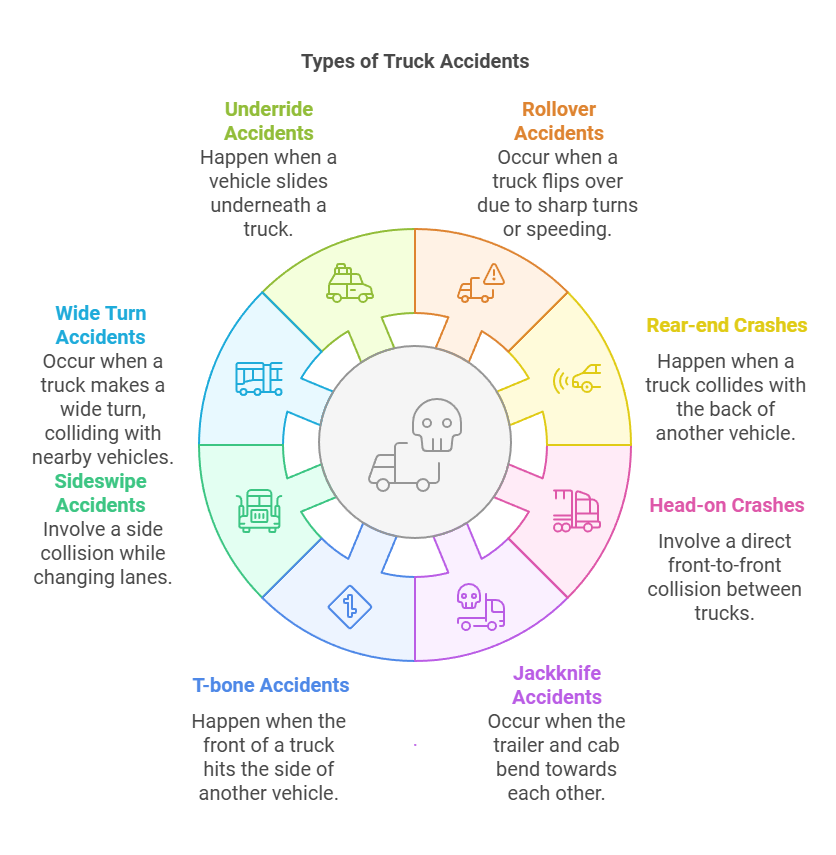
Truck crashes happen in a number of different ways. Here are the most common ones we handle and how they occur.
1. Rollovers
A truck flips onto its side or roof, often after a sharp turn, excessive speed, a sudden lane change, or poor maintenance.
2. Rear-end crashes
A truck strikes the vehicle in front of it — a car, bicycle, pedestrian, rideshare, motorcycle, or bus. Faulty brakes, distraction, speed, and fatigue are the usual culprits.
3. Head-on collisions
A truck crosses into oncoming traffic and hits a vehicle head-on, frequently because the driver was fatigued or impaired. These are among the deadliest crashes on the road.
4. Jackknife accidents
The trailer swings out and folds toward the cab at a sharp angle, like a pocket knife closing. It typically happens at high speed or on a hard turn.
5. T-bone accidents
The front of the truck slams into the side of another vehicle, often at an intersection where a driver ran a stop sign or ignored the right-of-way rules.
6. Sideswipe accidents
A truck and a nearby vehicle make contact side-to-side, usually when the trucker changes lanes or merges without checking a blind spot.
7. Wide-turn accidents
To make a right turn, a truck sometimes swings left first. When the driver misjudges the clearance, nearby vehicles get struck or trapped.
8. Underride accidents
A smaller vehicle slides underneath the truck’s trailer, often after a sudden stop. These crashes are catastrophic because the car’s safety features can’t protect against that kind of impact.
9. Tire blowouts
An underinflated, worn, or overloaded tire fails at speed, sending the truck out of control and scattering debris across the road.
10. Blind-spot accidents
Big rigs have large blind spots on all four sides. When a driver changes lanes without seeing a vehicle there, a collision is almost unavoidable.
Illinois Truck Crash Statistics
The numbers make the danger clear. In 2022, Illinois recorded 298,347 crashes with 83,783 injuries, and a significant share involved trucks.
Trucks involved in crashes:
| Truck types | Total crashes | Fatal crashes | Injury crashes |
| Total crashes | 298,347 | 1,147 | 59,795 |
| Pickup Truck | 42,298 | 226 | 8,263 |
| Truck-Tractor with Semi-Trailer | 13,009 | 155 | 2,022 |
| Other Single Unit Truck | 9,365 | 46 | 1,499 |
Among these crashes:
- Pickup trucks caused 101 deaths and 648 A-injuries
- Truck-tractors with semi-trailers caused 16 deaths and 76 A-injuries
- Other single-unit trucks caused 13 deaths and 47 A-injuries
Large trucks involved in work-zone crashes:
| Truck types | Injury crashes | A-injury crashes | Fatal crashes | Property damage | Total |
| Truck Single Unit | 66 | 10 | 3 | 320 | 389 |
| Tractor with Semi-Trailer | 210 | 27 | 18 | 1,201 | 1,429 |
| Tractor without Semi-Trailer | 9 | 1 | 1 | 60 | 70 |
| Single Unit Truck with Trailer | 22 | 2 | 0 | 102 | 124 |
| Total | 307 | 40 | 22 | 1,683 | 2,012 |
Source: Illinois Crash Facts & Statistics
Who Can Be Held Liable for a Truck Accident in Illinois?
One of the biggest differences between a truck case and a car crash is that more than one party is usually responsible. Under Illinois’s joint and several liability rule, 735 ILCS 5/2-1117, a defendant found 25% or more at fault can be held responsible for your full medical costs. Part of my job is identifying every party that shares the blame — because each one may carry insurance that contributes to your recovery.
The truck driver
If the driver was distracted, impaired, fatigued, speeding, or missed a vehicle in a blind spot, their negligence puts them on the hook for the damages.
The trucking company
Companies are liable when they push drivers past the FMCSA hours-of-service limits, cut corners on hiring, or send unsafe trucks onto the road. Their own records usually tell the story.
Cargo loaders and shippers
When a crash is caused by overloaded or improperly secured cargo, the company that loaded it can be held responsible for ignoring safety rules.
Parts manufacturers
If a defective part — brakes, tires, a coupling — failed and caused the crash, the manufacturer or supplier may share liability under product liability law.
Maintenance companies
A shop that failed to inspect or replace worn brakes and tires can be liable when that neglect leads to a collision.

What to Do After a Truck Accident
The moments after a truck crash are chaotic. If you’re able to, these steps protect both your health and your claim.
Get to safety. Check on everyone involved and move out of traffic if you can — but never leave the scene, which Illinois law prohibits.
Call 911. Report the crash and ask for medical help. A police report creates an official record you’ll need later.
Document everything. Photograph the vehicles, the road, your injuries, and the truck’s markings and license plate if you can do so safely.
Gather information. Try to collect:
- The driver’s contact and insurance details
- The trucking company’s name
- The truck’s license plate and DOT number
- The responding officer’s name and badge number
Talk to witnesses. Get names and phone numbers from anyone who saw what happened — their account can make or break a case.
Be careful with insurers. Report the crash to your own insurer, but don’t admit fault or give a recorded statement to the trucking company’s insurance before you’ve spoken with a lawyer.
Call a truck accident attorney. The sooner we’re involved, the more evidence we can preserve. That first call is free.
What Compensation Can You Recover?
Illinois law lets you recover both economic damages — the losses with a clear price tag — and non-economic damages for harms that are real but harder to measure. Depending on your case, that can include:
Medical bills: Everything from the ER visit through surgery, medication, and physical therapy, plus the care you’ll still need down the road.
Lost wages: The income you lose while you can’t work, as well as reduced earning capacity if your injuries affect you long-term.
Property damage: Repair or replacement of your vehicle and other property.
Pain and suffering: Compensation for the physical pain, emotional distress, and loss of enjoyment that follow a serious injury.
Disfigurement or disability: The lasting impact of scarring or permanent impairment on your daily life.
Wrongful death: When a family loses a loved one, they can recover for lost financial support, loss of companionship, and funeral costs.
How the Illinois Statute of Limitations Affects Your Claim
In Illinois, you generally have two years from the date of the accident to file a personal injury lawsuit, under 735 ILCS 5/13-202. Miss that deadline and you almost certainly lose the right to recover anything, no matter how strong your case was.
Two years can feel like plenty of time, but it isn’t. Evidence disappears, witnesses move, and insurers sometimes run out the clock on purpose. The earlier you contact a personal injury lawyer, the stronger your position.
How Long Will My Case Take to Settle?
Most Illinois truck accident cases resolve somewhere between six and sixteen months, though every case is different. Claims involving multiple defendants, disputed liability, or severe injuries tend to take longer. The timeline usually depends on:
- How long your medical treatment lasts
- How quickly we can gather records and evidence
- Whether the insurer negotiates in good faith or forces litigation
- The time it takes to negotiate medical bills and liens
I won’t rush you into a low settlement just to close a file. We take the time to get it right.
Should I Accept the Trucking Company’s First Offer?
Almost never — not without talking to a lawyer first. Trucking insurers often make a fast, low offer while you’re out of work and the bills are piling up, hoping you’ll take it out of stress. But once you accept and sign the release, it’s over: you can’t come back for more if your injuries turn out worse than expected. Let me review any offer before you respond to it.
What Our Clients Say
Talk to a Chicago Truck Accident Lawyer Today
If you or someone you love was hurt in a crash with a truck or semi anywhere in the Chicago area, I’d like to hear what happened. The consultation is free, you owe nothing unless we win, and you’ll deal with a lawyer who treats your case like it matters — because it does. Call us today and let’s talk about your next steps.
For a free legal consultation, call 312-261-5656Questions About Chicago Truck Accident Claims
When should I call a lawyer?
You should speak with a lawyer as soon as possible after a serious injury, especially before giving recorded statements, signing releases, or accepting a quick settlement. Early legal help can preserve evidence and identify every possible source of compensation.
What compensation may be available?
Depending on the facts, a claim may include medical expenses, lost income, reduced earning capacity, pain and suffering, disability, future care needs, and other losses tied to the injury.
What if an insurance company already contacted me?
Insurance companies often move quickly after an accident. Before making a statement or accepting payment, it is wise to understand whether the offer accounts for the full injury, future treatment, and long-term financial impact.
What related pages should I read?
Related legal services include Chicago car accident lawyer, Chicago construction accident lawyer, Chicago wrongful death lawyer.